 Skip to content

A 3 day itinerary Taupo and Tongariro is one of the most naturally structured trips available in New Zealand’s North Island. The first day belongs to the lake — the falls, the water, the geothermal landscape, the particular scale of a caldera that you have to stand at the edge of to fully understand. The second day belongs to the volcano — the most famous day walk in New Zealand, 19 kilometres across active crater terrain with views that extend further than you expect when you are standing inside them. The third day belongs to recovery and the quieter version of everything you covered in the first two. This guide structures all three days in an order that makes sense on the ground, with timing that gives each section enough space to land properly.
The itinerary is built around Taupo as your base for all three nights. The town is comfortable, well-equipped, and practical for both the lake activities on day one and the early Tongariro shuttle on day two. A car is required for the full itinerary, with the exception of the Tongariro Crossing transport, which is handled by shuttle operators running from Taupo accommodation.
The Best Time to do the crossing
At a Glance
| Base | Taupo, Lake Taupo, North Island |
| Duration | 3 days, 2 to 3 nights |
| Best season | November to April for the Crossing |
| Car required | Yes — essential for Days 1 and 3 |
| Crossing transport | Shuttle from Taupo — book in advance |
| Physical demand | Day 2 is high — 19.4km, 6 to 8 hours |
| Budget per day | NZD $80 to $200+ depending on activities |
Before You Go — What to Sort in Advance
Because Day 2 is the most logistically dependent day of the three, sorting the Tongariro Alpine Crossing transport before you leave home is the single most important pre-trip task. Shuttles fill quickly in summer and popular time slots sell out. Without a booked shuttle, Day 2 falls apart, because the Crossing is a point-to-point track and you cannot drive yourself between the two trailheads.
Booking the Crossing Shuttle
Several shuttle operators run from Taupo to the Mangatepopo trailhead, collecting from accommodation from approximately 5:30 AM. The return picks up from the Ketetahi end in the late afternoon. Booking the shuttle simultaneously with your accommodation removes the most common source of Day 2 anxiety. Additionally, the Crossing is weather-dependent and should not be attempted in high winds, heavy rain, or poor visibility — good operators allow free rescheduling for weather cancellations, which is a consideration worth factoring into your booking choice.
Browse Tongariro Alpine Crossing transport and guided tours on Viator →
What to Pack for the Crossing
Waterproof jacket and trousers, warm mid-layer, gloves, sun protection, at least 2 litres of water, food for a full day, and boots with ankle support. The Crossing traverses exposed alpine terrain regardless of the base temperature in Taupo, and the conditions on the upper section can differ significantly from the valley. Several walkers underestimate this each season and the consequences range from uncomfortable to dangerous. Pack for worse conditions than the forecast suggests and carry more food and water than you think you need.
Accommodation note
For Day 2, staying in Turangi the night before rather than Taupo reduces the morning drive to the Mangatepopo trailhead from 1.5 hours to around 30 minutes. If you prefer to do this, restructure the itinerary to move to Turangi on the evening of Day 1 and return to Taupo or continue south on Day 3. However, for most visitors, the Taupo base with an early shuttle pickup is the more practical approach and avoids the cost of a second accommodation location.
01
Day One
Arrive, Explore, Find the Lake
Day one is the orientation day. It is about understanding the scale of the lake, seeing Huka Falls, and getting the geothermal landscape under your skin before the harder physical work of the Crossing. Arrive early enough that the afternoon belongs to you rather than to the drive. If you are coming from Auckland, a 7 AM departure gets you to Taupo by mid-morning with time to do the day properly.
10:00 AM
Huka Falls
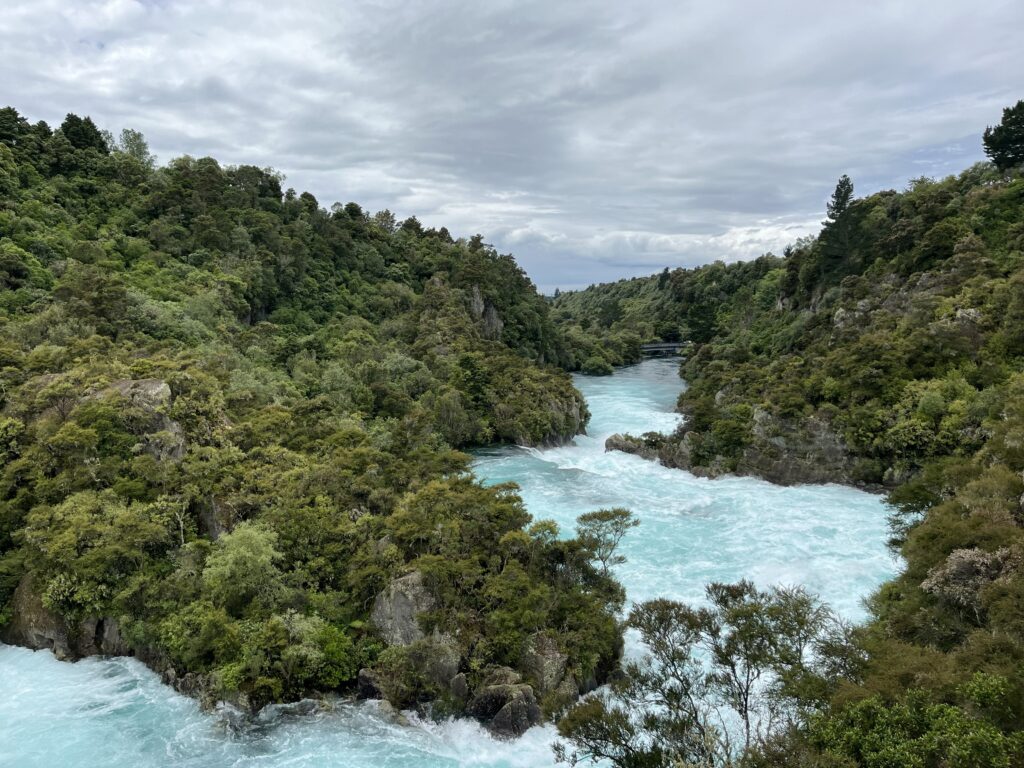
Drive eight kilometres north of the town centre on Huka Falls Road and start with the falls. The Waikato River narrows from 100 metres to 15 before dropping 11 metres into a turquoise pool. The viewing platform is five minutes from the car park. Stay longer than you think you need to. The falls earn it. Allow 45 minutes to an hour including the walk from the car park and time on the platform.
11:15 AM
Aratiatia Rapids
Drive a further five minutes northeast to the Aratiatia Dam. The 12 PM release is the most convenient on Day 1 if you arrive in good time. The gates open, the gorge floods, and the transformation from dry rock to raging river takes less than two minutes. Free entry. Arrive five minutes before the scheduled release. Because the water subsides quickly, timing is everything here.
12:30 PM
Check In and Lunch in Town
Return to Taupo, check into your accommodation, and find lunch on the town centre strip. Storehouse on Roberts Street handles breakfast into early afternoon and the cabinet food is worth noting. The lakefront has several casual options with water views if the day is clear. Because the afternoon is full, keep lunch to an hour and save the bigger dinner reservation for the evening.
2:00 PM
Craters of the Moon
Drive ten minutes north on SH1 to the Craters of the Moon geothermal park. The loop track takes around 45 minutes and passes boiling mud pools, active steam vents, and hydrothermal craters at close range. The entry fee is approximately NZD $8 for adults. This experience introduces the volcanic landscape in a way that makes the Tongariro peaks to the south feel more legible the following morning.
3:30 PM
Lake Taupo Lakefront Walk
Return to town and walk the lakefront. The promenade runs south from the boat harbour toward Two Mile Bay and north along the foreshore. Walk in either direction and spend an hour at the lake edge before dinner. On a clear afternoon the volcanic peaks on the southern horizon — Tongariro, Ngauruhoe, Ruapehu — are visible across the water. These are the same peaks you will be standing on tomorrow. Seeing them from the lake the evening before gives the Crossing a context that the early morning shuttle departure does not afford.
7:00 PM
Dinner
Two Mile Bay Sailing Club is two kilometres south of the town centre and the best lakeside dining in Taupo. The pizzas are consistently cited as among the best in the region and the view across the lake at dusk justifies the drive. Alternatively, Plateau on Tuwharetoa Street handles a mid-range dinner in the town centre without needing to drive. Book a table rather than walking in, particularly in summer.
9:00 PM
Early Night — Crossing Tomorrow
The shuttle collects from Taupo accommodation from approximately 5:30 AM. An early night is not optional. Lay out your gear, fill your water bottles, prepare your pack, and get to sleep before 10 PM. The Crossing asks more of you physically than most walks in New Zealand, and arriving at the trailhead rested makes a meaningful difference to the experience.
02
Day Two
The Tongariro Alpine Crossing
Day two is the Crossing. It is the reason most people plan a trip to this part of New Zealand and it earns the planning. The walk covers 19.4 kilometres of active volcanic terrain over six to eight hours. It crosses the South Crater, passes the Red Crater summit at 1,886 metres — the highest point of the route — descends past the vivid Emerald Lakes, and finishes through alpine scrub and native forest to the Ketetahi Road end. The landscape shifts dramatically across the day and the upper section, in particular, has a scale and a strangeness that is difficult to prepare for from photographs.
Early Morning — Shuttle and Trailhead
The shuttle collects from your Taupo accommodation between 5:30 and 6:30 AM depending on the operator. The drive to the Mangatepopo trailhead takes approximately 1.5 hours south via SH1 and SH47. Use the drive to eat breakfast in the vehicle rather than wasting time at a cafe before departure. The trailhead has toilet facilities and a small shelter. Most walkers begin moving by 7:30 to 8:00 AM, which gives a comfortable window to complete the Crossing before the late afternoon shuttle return.
7:30 AM
Mangatepopo Valley
The first section of the Crossing follows the Mangatepopo Stream through the valley below the volcanic cones. The gradient is gentle in this section and the pace is easy. Use this time to warm up and settle into a rhythm before the steeper terrain ahead. The valley views toward Mount Ngauruhoe — the near-perfect volcanic cone made famous internationally as Mount Doom — are best in the morning light before the sun rises fully overhead.
9:00 AM
Soda Springs and the Devil’s Staircase
Soda Springs is a small waterfall fed by geothermal activity approximately 3.5 kilometres from the trailhead. It is a natural rest stop before the steepest section of the Crossing — the Devil’s Staircase — which climbs from the valley floor to the South Crater rim. The staircase is the most physically demanding section of the route, involving a series of steep switchbacks on loose volcanic scree. However, it is also relatively short, and the South Crater opens at the top with an abruptness that rewards the climb immediately.
10:30 AM
South Crater and Red Crater Summit
The South Crater is a broad, flat volcanic basin surrounded by crater walls on three sides. Walking across it toward the Red Crater feels like crossing a landscape from a different geological era. The Red Crater summit at 1,886 metres is the highest point of the Crossing and the most exposed. On a clear day, the views extend across the Volcanic Plateau in every direction. Because wind can be severe at the summit, this is where the warm layer and wind protection earn their place in the pack.
11:30 AM
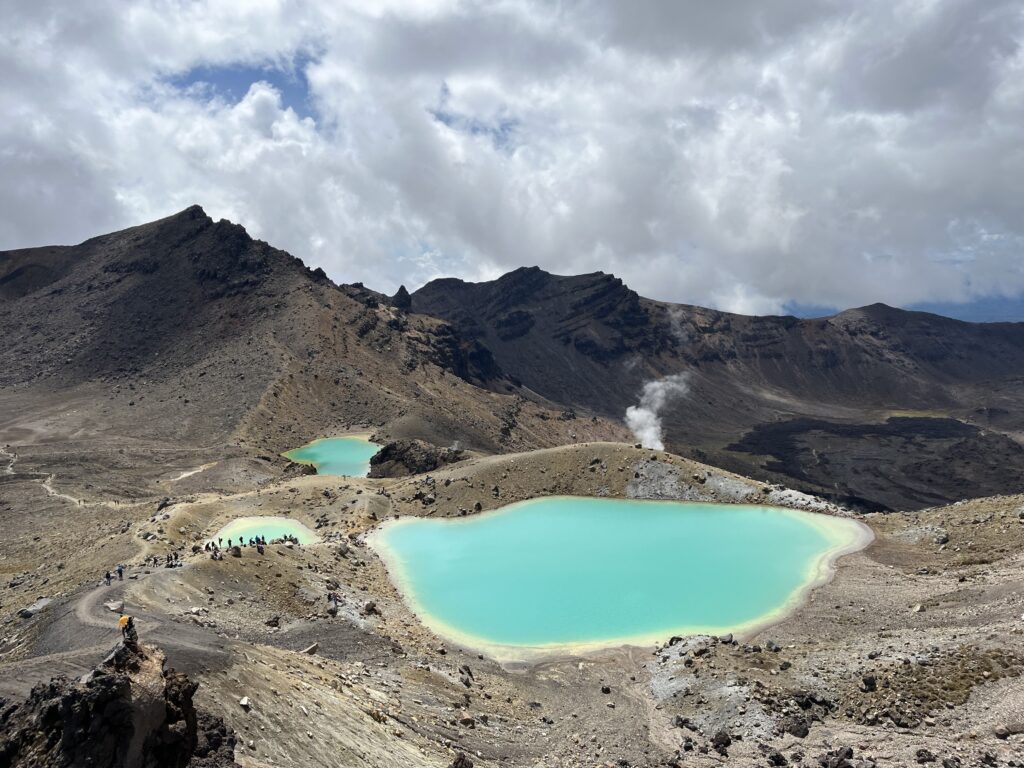
Emerald Lakes
The descent from the Red Crater to the Emerald Lakes is the most dramatic section of the walk — a steep drop on loose reddish scree with the three vivid turquoise lakes visible below from the moment you crest the summit. The colour of the Emerald Lakes is produced by dissolved minerals from the geothermal system. They look like something that has been digitally enhanced in photographs. In person they look exactly the same, which is one of the more pleasant surprises the Crossing offers. Eat lunch here. The setting earns a longer stop than most walkers allow themselves.
1:00 PM
Blue Lake and Upper Ketetahi
The trail continues past the Blue Lake — a sacred site that walkers must not enter or approach — and through the upper Ketetahi area. This section involves active geothermal venting visible from the track and offers the final elevated views across the Volcanic Plateau before the descent into bush begins. Because the Ketetahi Hut was damaged in a 2012 eruption and has not been fully replaced, there is no shelter in this section beyond what you carry.
2:30 PM
Descent Through Forest and Native Scrub
The final section descends from the exposed volcanic terrain through alpine scrub and eventually native forest before reaching the Ketetahi Road end. The change in vegetation as you drop altitude is striking — from bare scoria and tussock to dense beech and fern. Because legs are tired by this point, the track surface matters more than it did in the morning. Take it steadily on the steeper sections rather than rushing the end.
4:00 PM
Ketetahi Road End and Shuttle Return
The shuttle picks up from the Ketetahi end in the late afternoon and returns to Taupo, arriving back by early evening. The return journey takes around 1.5 hours. Most people on the shuttle are quiet. The Crossing produces a particular kind of tiredness that is also, reliably, a particular kind of satisfaction. The drive back through the King Country gives the volcanic landscape a final look from the road before Taupo comes into view.
7:00 PM
Dinner and Recovery
After returning to Taupo, shower, eat something substantial, and stop there. Plateau on Tuwharetoa Street handles a sit-down dinner without needing a reservation on weeknights. Alternatively, a simple takeaway and an early night suits the physical output of the day more honestly than a formal dinner. Either choice is correct. What matters is that the day ends properly rather than being extended past what the legs are capable of supporting.
Tongariro Alpine Crossing — Emerald Lakes, Red Crater
The Emerald Lakes look in person exactly as they do in photographs. That is one of the more pleasant surprises the Crossing offers. Most things like this disappoint. These do not.
03
Day Three
Recovery, Water, and the Lake
Day three is the recovery day and it earns that title. The Crossing asks a significant amount from most people and the third day is designed around what remains after that output — not by doing less, but by doing things at a different register. The lake, the thermal pools, the carvings from the water, a long lunch. All of it is within easy reach and none of it requires the kind of sustained effort that day two demanded.
8:30 AM
Slow Morning and Breakfast
Do not rush this. Storehouse on Roberts Street opens early and is the best breakfast option in the Taupo town centre. Alternatively, the lakefront has cafes that catch the morning light in a way that justifies a longer sit than usual. Because the rest of the day is unhurried, use the morning to recover properly rather than compressing it for an early start.
10:00 AM
Mine Bay Maori Rock Carvings Cruise
Book a lake cruise to the Mine Bay rock carvings — the largest Māori rock carvings in the Southern Hemisphere, accessible only by water. Several operators run morning departures from the Taupo Marina. The cruise takes around two hours and covers eight kilometres each way across Lake Taupo. The scale of the 10-metre carving of Ngatoroirangi becomes clear only from the water, and seeing it after two days immersed in the volcanic landscape that the same chief navigated gives it a context that a first-day visit would not provide.
12:30 PM
Lunch at Two Mile Bay Sailing Club
Drive two kilometres south of the town centre to Two Mile Bay Sailing Club. Order a pizza and sit on the deck with the lake directly in front of you. There is no better casual lunch location in Taupo. Because the legs will be feeling day two by this point, a long lunch is not indulgence — it is appropriate management of the situation.
2:30 PM
Wairakei Terraces or Spa Thermal Park
Choose between the Wairakei Terraces and Thermal Health Spa (paid, more comprehensive, silica terraces and cultural tour available) or the free Spa Thermal Park pools on County Avenue where natural hot water meets the Waikato River. For tired muscles after the Crossing, either option is correct. However, the Wairakei Terraces offer the more complete and atmospheric experience if the budget allows for it on the final afternoon.
5:00 PM
Lakefront Walk and Final Sunset
Walk the lakefront in the late afternoon. The light on Lake Taupo in the hour before sunset, with the volcanic peaks on the southern horizon catching the last of the day, is one of those images that stays specific rather than blending into general travel memory. The walk requires nothing beyond the willingness to be there at the right time. That is all most good endings require.
7:00 PM
Farewell Dinner
Bistro Lago at the Hilton Lake Taupo is the right choice for a final evening dinner — locally sourced New Zealand produce, a considered wine list, and a setting that matches the three days that preceded it. Reservations are recommended. Alternatively, Plateau handles an excellent mid-range farewell dinner in the town centre if the Hilton is beyond the budget or fully booked. Either way, take the time to finish the trip properly rather than eating quickly before the drive back.
Lake Taupo Sunset — Volcanic Peaks, Central North Island

Practical Notes for the Full Itinerary
Where to Stay
For this three-day itinerary, staying on the Taupo lakefront is the most practical and rewarding base. The lakefront accommodation puts you within walking distance of the town centre restaurants and the boat harbour while giving you the lake view that the itinerary builds toward on Day 1 and returns to on Day 3. Browse current availability and rates below.
Browse Taupo lakefront accommodation on Trip.com →
Weather Contingency for Day Two
The Tongariro Alpine Crossing is closed or unsafe in high winds, heavy rain, snow, or poor visibility. Because the upper section is exposed volcanic terrain at nearly 1,900 metres, the conditions can deteriorate rapidly regardless of the morning forecast in Taupo. Most shuttle operators have weather cancellation policies that allow rescheduling within a day or two. If you are visiting during a three-day window with one clear weather day, build the Crossing into that day regardless of the rest of the itinerary structure. The other days are considerably more flexible than Day 2.
Tongariro in Winter
The Crossing is possible in winter but requires alpine skills, crampons, and ice axes in many conditions. Additionally, the Department of Conservation recommends guided winter crossings rather than independent travel. If you are visiting between June and September, check current conditions at the DOC Tongariro Alpine Crossing page before committing to an independent crossing. In winter, the shorter Taranaki Falls track or the Silica Rapids track in Whakapapa Village offer worthwhile alternatives that do not carry the same alpine risk.
Extending the Itinerary
A fourth day allows for a visit to Wai-O-Tapu Thermal Wonderland approximately 40 minutes north of Taupo, which is one of the more spectacular geothermal parks in New Zealand. The Champagne Pool and the Artist’s Palette are genuinely impressive at scale. Alternatively, a fourth day based in Turangi allows for guided trout fishing on the Tongariro River and a visit to the Tokaanu Thermal Pools on the southern lake shore. Both options complement the three-day structure without duplicating it.
Frequently Asked Questions
Is 3 days enough for Taupo and the Tongariro Alpine Crossing?
Yes. Three days gives you enough time to see the best of Taupo, complete the Crossing as a full day, and have a proper recovery day at the lake and thermal pools. It is enough to feel the region rather than simply pass through it. A fourth day adds meaningful depth, but three is the minimum to do both Taupo and the Crossing properly.
Do I need a car for this Taupo and Tongariro itinerary?
Yes, a car is required for Days 1 and 3. The Crossing on Day 2 is handled by shuttle transport, so you do not need to drive to the trailhead yourself. However, Huka Falls, Aratiatia Rapids, Craters of the Moon, Two Mile Bay, and the Wairakei Terraces all require driving. Rental cars are available from Taupo Airport and several in-town operators.
What is the best time of year to do this 3 day Taupo itinerary?
November to April offers the best conditions for the Tongariro Alpine Crossing and the warmest lake temperatures for Day 3 activities. However, autumn between March and May is arguably the strongest overall window — the Crossing remains accessible, the crowds are lower than summer, accommodation prices drop, and the volcanic landscape is at its most atmospheric.
How difficult is the Tongariro Alpine Crossing?
The Crossing is rated as a demanding day walk, not a technical alpine route. However, it is 19.4 kilometres with significant elevation gain and exposed terrain at the summit. Good fitness, appropriate footwear, and proper clothing are essential. It is manageable for most reasonably fit adults, but it should not be underestimated. The upper section in particular requires care in the wind and on the loose scree descents.
Final Thoughts
A 3 day itinerary Taupo and Tongariro works because the two places complement each other at a pace and a scale that three days can hold properly. The lake on Day 1 gives you the context — the caldera, the volcanic peaks on the horizon, the understanding that everything in this landscape connects to the same underlying geological story. The Crossing on Day 2 puts you inside that story. The lake again on Day 3 gives you the distance to see it clearly.
Plan the shuttle early. Pack for the summit, not the valley. Let Day 3 be slower than the first two. In three days, this part of New Zealand shows you something that most visitors carry with them for considerably longer than the trip itself lasts.