 Skip to content


Updated 2026 · Glass House Mountains, Australia · Estimated read: 8 min
OneLife acknowledges the Kabi Kabi and Jinibara peoples as the Traditional Custodians of the Glass House Mountains and the wider Sunshine Coast. We pay our respects to their elders past, present and emerging, and to the enduring connection they hold to this land.
The Glass House Mountains are one of the most recognisable sights in South East Queensland. They rise straight out of the hinterland, a scatter of ancient volcanic peaks that catch the light long before you reach them. Long before they drew hikers and photographers, this was sacred ground, and it still is. To the Glass House Mountains traditional owners, this is not scenery. It is family, story and law.
Most visitors come for the walks and the views, and there is nothing wrong with that. A little understanding, though, changes the way the place feels underfoot. It also helps you choose the walks you are welcome on, and leave the ones you are asked to avoid.
This guide covers who the traditional owners are, why the peaks matter, which summits to leave alone, and how to visit with care. It is written for people who want to enjoy the mountains and still tread lightly.
Who Are the Glass House Mountains Traditional Owners?
The Glass House Mountains traditional owners are two distinct groups. They are the Kabi Kabi, also spelled Gubbi Gubbi, and the Jinibara people. Both have cared for this Country for thousands of years, and both still do.
The Jinibara are often described as the mountain people. Their Country reaches inland and takes in the western peaks and the Maleny area. In 2012 the Federal Court formally recognised Jinibara native title across much of this land.
The Kabi Kabi are their coastal neighbours, sometimes known as the saltwater people. Their connection runs along the shore from the mountains north through Noosa. In June 2024 the Kabi Kabi were recognised as native title holders over an estate of more than 350,000 hectares.
These are living connections, not distant history. The families who hold this Country are here now, and the recognition of their rights is recent.
A Family of Peaks
In the culture of the traditional owners, the mountains are understood as a family. Tibrogargan is the father. Beerwah, the tallest, is the mother. Coonowrin, also called Crookneck, is the eldest son. The smaller peaks, Ngungun among them, are the children.
The full story behind those names belongs to the Kabi Kabi and Jinibara peoples. It is theirs to tell, not ours to retell, and the best place to hear it is from them. There are links to their own words further down.
The European name arrived much later. Captain Cook recorded the peaks from the water in 1770 and called them the Glass Houses, after the glass furnaces of his native Yorkshire. Those older names carry more than a passing resemblance. They carry meaning that predates the map.
A Living Culture, Not a Relic
It helps to remember that this Country has been a gathering place for a very long time. The traditional owners moved with the seasons, held ceremonies, and came together with neighbouring groups for events that drew people from across the wider region. The mountains were a landmark for all of it.
That life did not end. The Kabi Kabi and Jinibara peoples continue to care for their places and sites of significance, and native title carries a formal right to protect them. When you stand among the peaks, you are standing in a cultural landscape that is still being looked after, not one that was left behind.
The Peaks You Are Asked Not to Climb
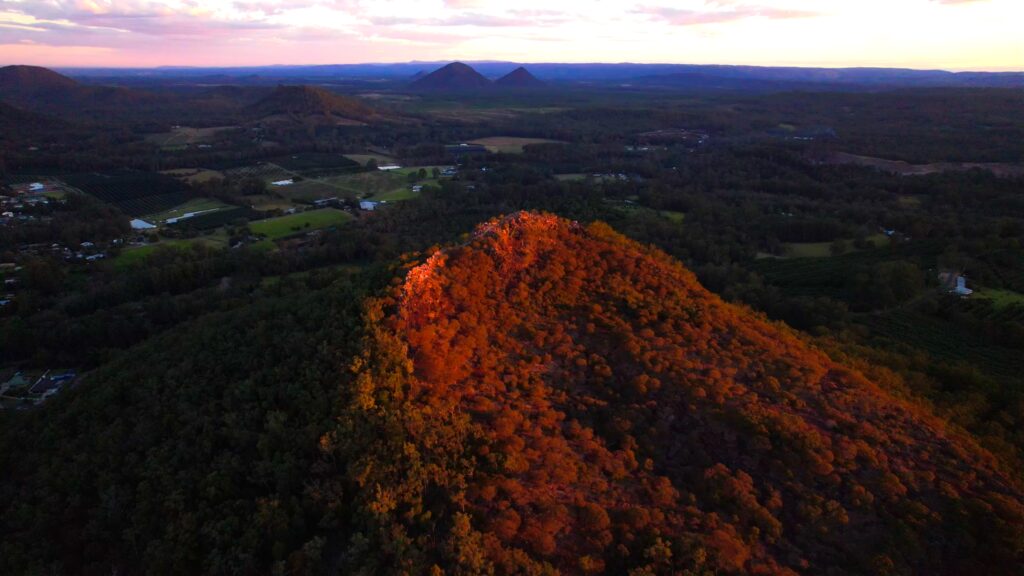
This is where respect matters most. For the traditional owners, Beerwah and Tibrogargan are not summits to be conquered. They are living representations of cultural heritage, and visitors are asked to consider that before setting foot on them.
Rangers and traditional owners ask people not to climb Beerwah and Tibrogargan. The request is cultural first. It is also a safety matter, since both are steep, exposed and unforgiving in poor weather.
The Walks That Welcome Visitors
There is still a great deal to see, and some walks are genuinely encouraged. Mount Ngungun is the one most people are pointed toward. A short climb through open forest leads to a summit with wide views of the taller peaks and the coast beyond. It is the recommended summit, and a beautiful one at that.
If climbing is not for you, the lookouts do the work instead. The Glass House Mountains Lookout takes in the whole range in a single sweep. A little further south, the walk to the top of Wild Horse Mountain is short and rewards you with another wide outlook.
Lower tracks and boardwalks thread through the national park as well. You can spend a full morning among the peaks without ever standing on a sacred summit.
How to Visit the Glass House Mountains Respectfully
A few simple habits carry most of the weight. Stay on the marked tracks. Carry your rubbish out with you. Leave rocks, plants and any cultural markings exactly as you found them.
Never carve, paint or mark the rock. Vandalism has been a real and ongoing problem across these peaks, and it causes lasting harm to the people who hold this Country. No dogs should be brought into the areas of the national park where they are not permitted. Check signage.
If you want to understand the place more deeply, consider a walk or tour led by a First Nations guide. Hearing the stories from the people whose stories they are is a different experience entirely, and it supports the community directly.
A note worth keeping: the most respectful choice here is also the easiest.

Learn More From the Communities
The best sources are the communities themselves and the park that protects this land. The Sunshine Coast Council First Nations heritage pages set out the history of the Kabi Kabi and Jinibara peoples clearly and with care. You can read them at the Sunshine Coast Council First Nations heritage site.
Queensland Parks and Wildlife Service publishes current track conditions, closures and cultural guidance for the national park. Check it before any visit, as access can change.
The Kabi Kabi and Jinibara peoples also share their histories and cultural work through their own community organisations.
Before the Gate
The two-page checklist I run through before every trip overseas. Free, straight to your inbox.
Get the checklistFrequently Asked Questions
Are the Glass House Mountains sacred?
Yes. They hold deep cultural and spiritual significance for the Kabi Kabi and Jinibara peoples. The peaks are understood as a family and sit at the centre of local culture and Dreaming.
Can you climb the Glass House Mountains?
Some of them. Mount Ngungun is open and recommended.
Who are the traditional owners of the Glass House Mountains?
The Kabi Kabi, also known as Gubbi Gubbi, and the Jinibara people. Both hold recognised native title across parts of the region.
How do you pronounce Ngungun?
It is usually said as noo-noo, though many locals say gun-gun. Either way, using the name with care is part of showing respect.
Do you need permission to visit the Glass House Mountains?
No. The national park is open to everyone. The request is simply that you visit with respect, stay on open tracks, and leave the sacred peaks unclimbed.
Final Thoughts
The Glass House Mountains reward the people who slow down. Understanding the Glass House Mountains traditional owners, and the meaning these peaks carry, turns a simple walk into something closer to a privilege.
There is a quieter kind of travel available here, one that takes the view without needing to take the summit. Climb the peak you are welcome on. Sit with the silence at the top. Let the rest stand as they have stood for far longer than any of us.
Choose the walks that welcome you. Leave the sacred ones be.