 Skip to content

Updated 2026 · Senso-ji, Asakusa, Tokyo · Estimated read: 10 min
Senso-ji is the oldest temple in Tokyo, and it rarely feels its age. Around 30 million people pass through its gates each year. Yet reach it before the shops open, and the place is almost still. This Senso-ji Temple guide is about seeing it well, not just seeing it.
The temple sits in Asakusa, an old quarter on the Sumida River. You approach it through a giant red gate and a street of centuries-old stalls. By the time you reach the main hall, you have already walked through most of the story.
Below you will find the history, how to get there, and what to actually look for. This Senso-ji Temple guide also folds in Nakamise street and the wider Asakusa surrounds. One visit can fill a morning or a full day.
More Tokyo, from OneLife:
Best temples and shrines in Tokyo
Things to do in Asakusa (guide coming soon)
Tokyo for first-timers (guide coming soon)
What Is Senso-ji: A Short History
Senso-ji began with a legend and a river. In the year 628, two fishermen brothers pulled a small golden statue of Kannon from the Sumida. They tried to return it to the water, and it kept finding its way back.
So the villagers built a temple to keep it. The main hall was completed in 645. That makes Senso-ji the oldest temple in Tokyo by a wide margin.
The statue is still said to rest inside, hidden from view. Nobody has seen it for centuries, and the inner sanctum has never been opened. What draws the crowds is the devotion around it, not the object itself.
Senso-ji honours Kannon, the deity of compassion. Its full name is Kinryuzan Senso-ji, the Temple of the Golden Dragon Mountain. War flattened much of it in 1945. The buildings you see are careful postwar rebuilds, down to a titanium roof made to look old.
How to Get to Senso-ji
Nearest station and from the city centre
Senso-ji is easy to reach, which is part of why it is so busy. The temple sits about five minutes on foot from Asakusa Station.
Four lines run into Asakusa. The Tokyo Metro Ginza Line and the Toei Asakusa Line are the usual choices. The Tobu Skytree Line and the Tsukuba Express also stop here.
From central Tokyo, count on twenty to thirty minutes. From Shibuya or Shinjuku it takes a little longer, with one change. Leave the station and follow the crowds toward the giant lantern.
Tip
Ride in on the Ginza Line and leave by the river. A short walk to the Sumida gives you the temple, the water, and the Tokyo Skytree in one frame.
What to See at Senso-ji
You could rush Senso-ji in twenty minutes. Give it two hours and it opens up. Here is what deserves your attention, in the order you meet it.
Kaminarimon, the Thunder Gate
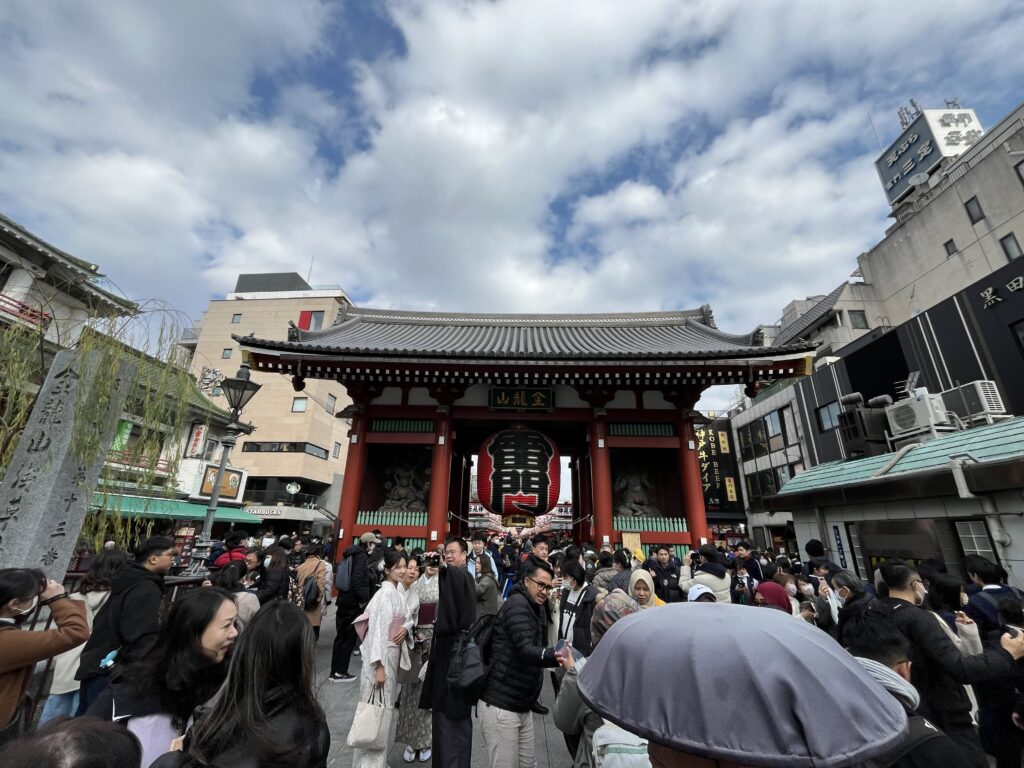
The first gate is the one everyone knows. Kaminarimon means Thunder Gate, and its huge red lantern weighs around 700 kilograms. Two guardian gods stand on either side, watching who comes in.
The gate itself never closes. Arrive early and you can photograph it almost alone. By late morning it becomes a wall of raised phones.
Nakamise-dori, the approach
Through the gate runs Nakamise, the approach to the temple. It stretches about 250 metres, lined with dozens of small shops. Traders have sold to pilgrims here for centuries.
The goods have changed, the rhythm has not. Look for ningyo-yaki, little cakes filled with red bean, and freshly grilled rice crackers. Folding fans, cotton yukata and paper lanterns fill the rest.
Nakamise rewards a slow walk. It also rewards a second one, once on the way in and again on the way out, when the light and the crowds have shifted.
Hozomon gate and the main hall
A second gate, Hozomon, marks the inner grounds. On its far side hang two giant straw sandals, a charm meant to ward off evil. Beyond it stands the Hondo, the great main hall. Toss a coin, bow, and make a quiet wish.
Before the steps, most people pause at the large bronze cauldron. Smoke from the incense is said to heal. Visitors waft it over a sore shoulder or a tired head.
Off to one side sits the fortune counter. Draw an omikuji, read your luck, and tie a poor one to the wire so it stays behind. A hundred yen hands your bad year to the wind.
The five-story pagoda
Left of the main hall rises the five-story pagoda. It lifts against the Tokyo Skytree behind it, old and new in a single view. Photographers wait here for the light to soften.
If you would rather have the stories told to you, a guided Asakusa walk covers the gate, Nakamise and the temple in about two hours.

Tickets, Hours and What It Costs
Here is the simplest part of any Tokyo landmark. Senso-ji is free.
There is no entry fee for the grounds, the gates, Nakamise or the main hall. Donations are welcome, and a fortune slip or an amulet costs only a little. A goshuin, the calligraphed temple stamp, runs around 500 yen.
The grounds never close. You can walk them at any hour, and the buildings stay lit into the late evening. The main hall keeps shorter times, roughly six in the morning until five, opening half an hour later from October to March.
Nakamise shops follow their own clock, generally from mid-morning to early evening. So the temple is a dawn or dusk pleasure, while the street is a daytime one. For live hours and festival dates, check the temple’s own site before you go.
Best Time to Visit Senso-ji
Timing changes everything here. The same courtyard can feel sacred or swamped, depending on the hour. Season matters too, with cherry blossom along nearby Sumida Park in spring and gold light in autumn.
Early morning is the prize. Between six and eight, the hall opens, the incense is fresh, and you might share the grounds with fifty people rather than five thousand. Winter mornings sometimes bring mist drifting through the pagoda.
Evening is the other window. Once the main hall closes, the crowds thin and the buildings glow under floodlight until around eleven. Since the grounds stay open, an after-dark stroll is one of Tokyo’s finest free hours.
Skip the middle of the day if you can, and skip the first three days of January. During Hatsumode, the new year visit, millions arrive and the queues stretch for blocks.
Tip
Do the temple at opening, then eat breakfast in Asakusa while Nakamise wakes up. You get the quiet version of both.
What Is Nearby
Senso-ji anchors Asakusa, but the quarter rewards a wider wander. Most of it sits within a short walk.
Right beside the main hall stands Asakusa Shrine, known as Sanja-sama. It honours the men behind the temple’s founding and came through the wartime bombing intact. Its Sanja Matsuri, held each May, is one of Tokyo’s wildest festivals.
Across from Kaminarimon, the Asakusa Culture Tourist Center hides a free viewing deck on its top floor. Ride the lift up for a clean look down Nakamise toward the temple, with the Skytree beyond.
Walk east and you reach the Sumida River. Sumida Park lines the bank, and sightseeing boats leave the pier for Odaiba and further afield. For temple architecture across the rest of the city, our guide to the best temples and shrines in Tokyo maps the route.
Rickshaw pullers wait near the gate, offering short narrated loops of the old streets. Hungry travellers can drift toward Kappabashi, the kitchenware street, or settle into an old Asakusa tempura or monjayaki house. The area also makes an easy base for a night, close to the river and well connected across the city.
Is Senso-ji Worth Visiting
Senso-ji is one of the busiest sights in Japan, and that puts some travellers off. The honest answer depends on when you go and what you want.
For first-time visitors to Tokyo, it is close to essential. Nowhere else gives you this much history, ritual and street life in one easy stop. Go early and it will likely be a highlight.
For return visitors and quieter souls, the daytime crush can grate. The fix is the same. Come at dawn or after dark, when the temple settles back into something closer to itself.
For photographers and culture seekers, it is a gift. The gates, the pagoda and the Skytree line up beautifully, and the rituals are real rather than staged for visitors.
Frequently Asked Questions
Is Senso-ji worth visiting?
Yes, especially on a first trip to Tokyo. It packs centuries of history, living ritual and old-town atmosphere into one free, central stop. Arrive early or after dark and it is genuinely special.
How long should I spend at Senso-ji?
Allow two to three hours. That covers Kaminarimon, Nakamise, the main hall and the pagoda, with time for Asakusa nearby. A quick look takes twenty minutes, but you will miss the best of it.
Is Senso-ji free to enter?
Yes. The grounds, gates, Nakamise street and main hall are all free. Only small extras cost anything, like a fortune slip, an amulet or the temple stamp.
What is the best time to visit Senso-ji?
Early morning, from six to eight, or the evening after the hall closes. Both bring thinner crowds and better light. Avoid the midday hours and the first three days of January.
How do I get to Senso-ji?
Ride to Asakusa Station and walk about five minutes. The Ginza Line and Toei Asakusa Line are the easiest, and the Tobu Skytree Line and Tsukuba Express also stop there.
Is this Senso-ji Temple guide enough for a first visit?
It covers what you need to plan the visit, from access and hours to what to see and when to arrive. For live hours and festival dates, check the temple’s official site before you travel.
Final Thoughts on Senso-ji
Senso-ji works because it refuses to be only one thing. It is a working temple, a shopping street, a photo stop and a piece of old Tokyo, all at once.
Come at the wrong hour and you will see the crowds. Come at the right one and you will see why they bother. The trick, as with most great places, is to arrive before everyone else.
Use this Senso-ji Temple guide to time it well, then let Asakusa do the rest. The oldest temple in Tokyo still has a way of making a morning feel like a discovery.
This post contains affiliate links. If you book or purchase through them I may earn a small commission at no extra cost to you.