 Skip to content

Updated 2026 · Meiji Jingu, Harajuku, Tokyo · Estimated read: 9 min
Step out of Harajuku Station and you face a choice. Turn one way for neon, crepes and teenage fashion. Turn the other for a forest, a giant wooden gate, and near silence. This Meiji Shrine guide is about the quiet side, and how to pair it with the loud one.
Meiji Jingu is Tokyo’s grandest Shinto shrine, hidden inside a man-made forest. It honours Emperor Meiji, the ruler who steered Japan into the modern world. Most visitors are surprised that this much stillness survives in the middle of the city.
Below you will find the history, how to get there, and what to look for. This Meiji Shrine guide also covers Takeshita Street and Harajuku, which sit right at the shrine gates. Two very different Tokyos, one short walk apart.
More Tokyo, from OneLife:
Best temples and shrines in Tokyo
Senso-ji Temple guide (coming soon)
Tokyo for first-timers (guide coming soon)
What Is Meiji Shrine: A Short History
Meiji Shrine is younger than it looks. It was dedicated in 1920, soon after Emperor Meiji and Empress Shoken had died. The shrine honours their spirits, not a god from ancient myth.
Emperor Meiji matters to modern Japan. He reigned as the country opened to the world and remade itself in a few short decades. The shrine stands as a thank-you to that era.
The forest around it is the real marvel. Over 100,000 trees were donated from every corner of Japan and planted by volunteers. What looks ancient and wild was designed from scratch, meant to grow into an eternal wood. Planners chose around 365 species and arranged them so the wood would renew itself without replanting. Today it shelters birds and insects rarely seen in the city, a real ecosystem grown from a plan.
War took the original buildings in 1945. The shrine you see was rebuilt in 1958, in the same cypress and the same calm style. A century on, the forest has done exactly what its planners hoped.
How to Get to Meiji Shrine
Nearest station and from the city centre
Meiji Shrine could hardly be easier to reach. The main entrance sits a two-minute walk from Harajuku Station on the JR Yamanote Line.
Meiji-jingumae Station, on the Tokyo Metro Chiyoda and Fukutoshin lines, is just as close. Yoyogi and Sangubashi stations serve the quieter northern gate.
From most of central Tokyo, the Yamanote Line loops you here in under twenty minutes. Come out, cross to the tall torii gate, and the forest starts at once.
Tip
Enter from Harajuku and leave by the north gate near Yoyogi, or the reverse. Walking the full length of the forest is half the experience.
What to See at Meiji Shrine
Meiji Shrine rewards a slow walk more than a checklist. Still, a few things are worth pausing for.
The great torii and the forest approach
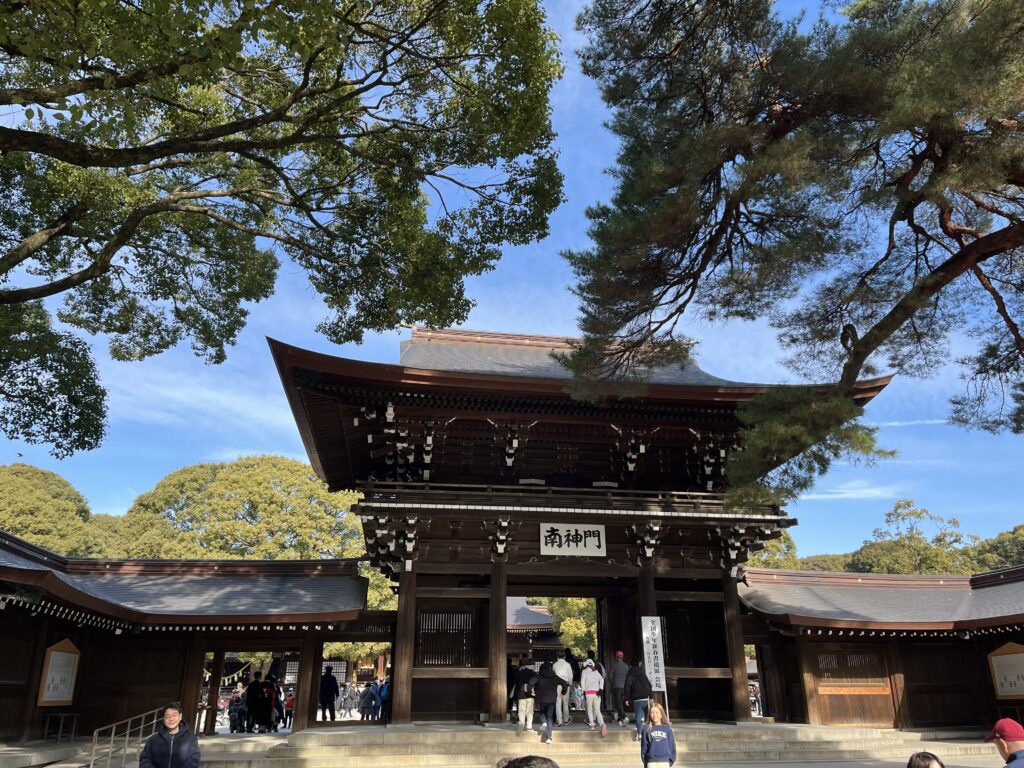
The first torii is one of the largest wooden gates in Japan. It is cut from cypress more than 1,000 years old, and it marks the line between city and sanctuary. Bow slightly as you pass, the way locals do.
Beyond it, a wide gravel path winds through the trees. The traffic noise fades within a minute. This walk, more than any single building, is the point of a visit.
The sake and wine barrels
Partway along, two walls of barrels face each other. On one side sit rows of sake casks, offered by brewers across Japan. On the other stand barrels of Burgundy wine, sent from France.
The pairing is not random. Emperor Meiji embraced the West as Japan modernised, and even took to wine. The barrels are a quiet nod to that open door, and the most photographed spot on the approach.
The main shrine and the couple trees
At the heart of the forest stands the main shrine, built in cypress around a wide courtyard. Toss a coin, bow twice, clap twice, then bow once more. It is simple, and nobody minds if you are unsure.
Look for the two great camphor trees joined by a sacred rope. They are known as the couple trees, a symbol of marriage and harmony. Visitors leave wishes on wooden ema plaques nearby, many of them for love.
The shrine runs no official tours, but a private guide fills in the history well. A guided walk of the shrine and Harajuku takes about two hours and joins the two worlds in one loop.
The Inner Garden
For a small fee you can slip into the Inner Garden, a landscaped retreat that predates the shrine. Its iris beds peak in mid-June, when the whole field turns violet. At the far end sits Kiyomasa’s Well, a spring long treated as a place of good fortune. Near the entrance, the Meiji Jingu Museum, designed by Kengo Kuma, shows the imperial couple’s effects, including Emperor Meiji’s carriage.

Tickets, Hours and What It Costs
The main part is easy. Meiji Shrine is free to enter.
There is no charge for the grounds, the gates, the forest or the main shrine. Two extras cost a little. The Inner Garden asks around 500 yen, and the Meiji Jingu Museum around 1,000.
The gates open with the sun and close with it, so the hours shift through the year. Expect an opening near six in the morning and a close between late afternoon and early evening. In deep winter the shrine shuts around four.
The Inner Garden keeps its own hours, roughly nine to half past four, with longer days in June. The museum runs late morning to late afternoon and closes on Thursdays. For exact times by month, check the shrine’s own site before you go.
Best Time to Visit Meiji Shrine
Early morning is the answer, almost every time. The shrine opens at sunrise, and the first hour belongs to the light and the birds. Mist sometimes hangs in the trees, and you may share the path with only a handful of people.
Weekends bring a different reward. Traditional Shinto weddings are often held then, and you might catch a procession crossing the courtyard under red parasols. It is a real ceremony, not a show.
June is the season for the Inner Garden, when the irises bloom. Autumn brings colour to the forest edges. Any weekday, at any time of year, feels calmer than a weekend afternoon.
One time to plan around is early January. During Hatsumode, the new year visit, Meiji Jingu draws more worshippers than any shrine in Japan. The queues are vast, so come only if the atmosphere is the point.
Tip
Do the shrine at opening, then walk into Harajuku as the shops lift their shutters. You get the peaceful forest and the fresh street, both at their best.
What Is Nearby: Takeshita Street and Harajuku
Cross back over the railway from the shrine and the mood flips completely. This is Harajuku, the home of Tokyo youth culture, and it begins within sight of the torii.
Takeshita Street is the loud heart of it. The narrow lane runs a few hundred metres, packed with cheap fashion, novelty shops and rainbow crepe stands. It is bright, busy and unmistakably young. Go once for the spectacle, even if you buy nothing.
For a calmer version, walk a block to Omotesando. The wide, tree-lined avenue is Tokyo’s answer to a designer boulevard, with bold architecture between the flagship stores. Cat Street links the two, full of small labels and coffee.
Yoyogi Park sits on the shrine’s other flank, wide and green and made for a slow afternoon. On Sundays it draws dancers, buskers and picnic crowds. For more of the city’s sacred side, our guide to the best temples and shrines in Tokyo maps the rest.
Is Meiji Shrine Worth Visiting
Meiji Shrine is one of Tokyo’s most visited sights, and it earns the crowds. The honest answer, as ever, depends on timing and taste.
For first-time visitors, it is close to essential. Nowhere else in central Tokyo offers this much calm, and the forest walk alone is worth the trip. Pair it with Harajuku and you get the whole range of the city in one morning.
For those who dislike crowds, the fix is simple. Arrive at opening on a weekday and the forest is nearly yours. By midday it fills, so the early hour is the whole game.
For culture and photography, it is a gift. The torii, the barrels and the wedding processions are quietly cinematic. Set against Harajuku next door, the contrast is the real photograph.
Frequently Asked Questions
Is Meiji Shrine worth visiting?
Yes, especially on a first trip to Tokyo. The forest and the torii offer rare calm in the city centre, and it is free. Go at opening and pair it with Harajuku next door.
How long should I spend at Meiji Shrine?
Allow about an hour for the shrine and forest walk. Add another hour for the Inner Garden or the museum. With Takeshita Street next door, plan half a day for the whole area.
Is Meiji Shrine free to enter?
Yes. The grounds, gates and main shrine are all free. Only the Inner Garden and the Meiji Jingu Museum charge a small separate fee.
What is the best time to visit Meiji Shrine?
Early morning on a weekday, right at opening. The forest is quietest then, and the light is best. Weekends can bring traditional weddings, which are worth catching.
How do I get to Meiji Shrine?
Walk two minutes from Harajuku Station on the JR Yamanote Line. Meiji-jingumae Station on the Tokyo Metro is just as close. Most of central Tokyo is under twenty minutes away on the loop line.
Is Takeshita Street close to Meiji Shrine?
Very. Takeshita Street sits directly across from Harajuku Station, opposite the shrine entrance. You can walk from forest calm to fashion chaos in a few minutes, which is why the two pair so well.
Is this Meiji Shrine guide enough for a first visit?
It covers the history, access, costs and timing, plus Harajuku next door. For exact monthly hours and event dates, check the shrine’s official site before you travel.
Final Thoughts on Meiji Shrine
Meiji Shrine works because of what sits beside it. A silent forest and a loud fashion street share one station, and somehow the city holds both. Tokyo rarely explains itself better than here.
Give the shrine the early hours, when the gravel is empty and the light is soft. Then let Harajuku wake up around you. You will have seen two sides of the same place in a single morning.
Use this Meiji Shrine guide to time it right, and the rest takes care of itself. Few first mornings in Tokyo land better than this one.
This post contains affiliate links. If you book or purchase through them I may earn a small commission at no extra cost to you.