 Skip to content

Travel Guides · New Zealand · Updated 2026 · 10 min read
Rotorua sits on some of the most active geothermal ground on earth. Steam drifts up between houses, and the air carries the faint scent of sulphur. This is the reason many people come. The best geothermal attractions in Rotorua run from vivid coloured pools to erupting geysers, boiling mud and warm water you can bathe in. Some are grand, some are free, and all are close.
The variety is the appeal. One park is known for its colours, another for a geyser, another for mud you can soak in. A few sit right in the city. Others are a short drive out.
This guide covers the ones worth your time, with prices and what to expect at each. A word on safety runs through it too. This ground is beautiful and genuinely dangerous.
Read Next
3 Days in Rotorua: The Perfect Itinerary
The Best Geothermal Attractions in Rotorua
The best geothermal attractions in Rotorua split into a few kinds. There are the colourful walk-through parks, the geysers, the boiling mud, and the warm pools made for soaking. Some sit in the city, others a short drive south or east. Here is where to begin.
Wai-O-Tapu Thermal Wonderland
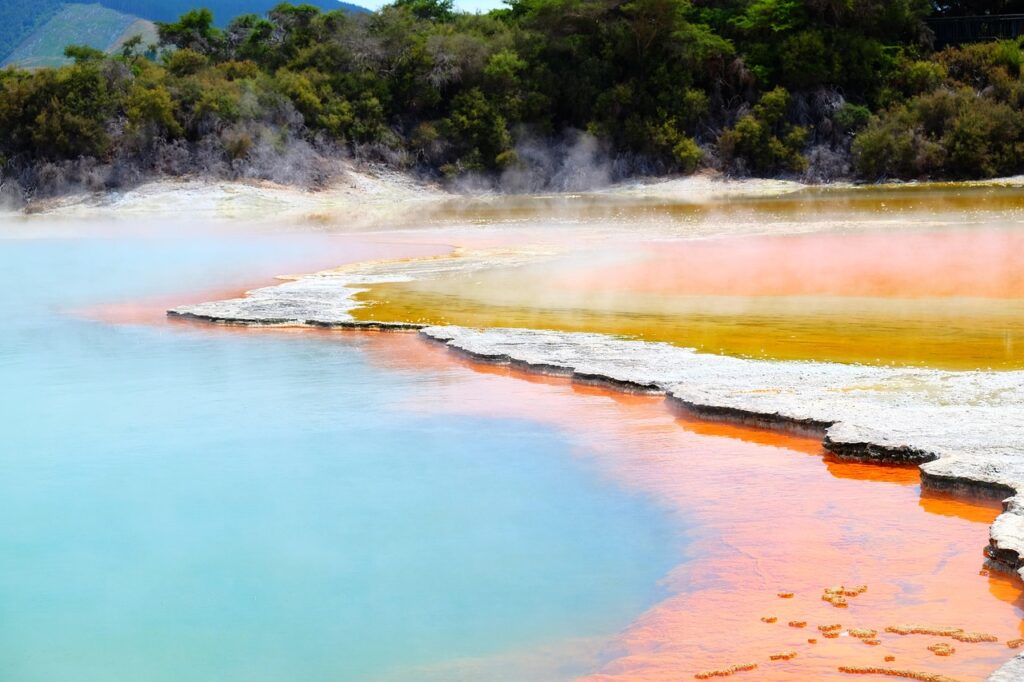
Wai-O-Tapu is the most famous geothermal park in the country, and the one most people picture. It lies about 29 kilometres south of the city, a 25-minute drive down State Highway 5. The colours here are the draw, drawn from minerals in the ground: terracotta, jade, orange and sulphur yellow.
The Champagne Pool is the centrepiece, a huge steaming spring rimmed in vivid orange. Nearby sit the bright green Devil’s Bath and the Artist’s Palette. Three looping walks take between 45 and 90 minutes, along well-marked paths through the reserve.
The Lady Knox Geyser erupts each morning at 10:15, reaching up to 20 metres. The eruption is triggered with a little soap, so go early and see it first, then walk the park. Adult entry is around NZ$47. You can book Wai-O-Tapu tickets here, or check the official website for hours.
Price: around NZ$47 adult · Time: 2 to 3 hours · Best for: colour, the geyser and a first geothermal visit.
Te Puia and the Pōhutu Geyser
Closest to the city, Te Puia is home to Pōhutu, the largest active geyser in the southern hemisphere. It erupts through the day, often to 30 metres, sometimes higher. Around it sit boiling mud pools and steaming ground in the Whakarewarewa Geothermal Valley.
Te Puia pairs its geothermal features with Māori culture, including the arts and crafts institute and daytime performance. That makes it a strong two-in-one stop. An after-dark experience now lets you see the geyser lit and quiet by night.
Price: check current rates · Best for: a reliable geyser and culture together.
Waimangu Volcanic Valley
Waimangu is the youngest geothermal system in the world, created by the 1886 eruption of Mount Tarawera. That history gives it a raw, wild feel the older parks do not have. It is quieter too, walked rather than crowded, through regenerating bush.
The valley holds Frying Pan Lake, the largest hot spring on earth, and the eerie blue Inferno Crater. A downhill walking trail leads through it, with a shuttle back to the top. You can add a cruise on Lake Rotomahana, over the site of the lost Pink and White Terraces.
The valley walk costs around NZ$75, and the full experience with cruise around NZ$180. Last admission is early afternoon, so arrive with time. The Waimangu website has current times.
Price: around NZ$75 walk, NZ$180 with cruise · Time: 2 to 4 hours · Best for: nature, space and volcanic history.
Hell’s Gate (Tikitere)
A short drive east, Hell’s Gate is the most active geothermal park in the area, and the only one owned and run by Māori. Its Māori name is Tikitere, and the land carries its own stories. Boiling pools, a hot waterfall and steaming ground fill the reserve.
What sets it apart is the chance to get in. The park runs a geothermal mud bath and sulphur spa, long valued for the skin and the body. You can combine the walk with a soak, which makes it more than a place to look at.
Price: check current rates · Best for: active geothermal and a mud bath soak.
Kuirau Park
Not every geothermal site here costs money. Kuirau Park sits right in the city and is completely free. It holds steaming lakes, bubbling mud pools and vents, all within a public park you can wander at will.
There are free foot baths where you can soak tired feet in warm mineral water. The ground here is genuinely live, and new vents have opened without warning over the years, so stay behind the fences and on the paths. It is the easiest geothermal stop in town, and it costs nothing.
Price: free · Best for: a quick, free geothermal walk and foot baths.
Orakei Korako
About an hour south, Orakei Korako is the hidden one. It is reached by a small boat across a lake, which adds to the sense of arriving somewhere apart. Fewer visitors make it here, so it stays quiet and otherworldly.
Large silica terraces spill down the hillside in soft colours, alongside geysers and hot springs. A boardwalk winds through the whole valley. If you want geothermal scenery without the tour buses, this is the pick.
Price: check current rates · Time: half a day with travel · Best for: quiet, dramatic terraces.
Whakarewarewa: Cooking in the Steam
Next to Te Puia, the Whakarewarewa living village shows geothermal energy still in daily use. This is a real village, home to Māori families, where the hot ground is used to cook, bathe and heat homes. A guided tour, led by residents, explains how it all works.
You can watch food cooked in the steam and even buy corn cooked that way. It is geothermal not as spectacle but as everyday life. Because it is a home, move gently and follow your guide.
Price: check current rates · Best for: seeing geothermal energy used in daily life.
Polynesian Spa
To bathe rather than walk, the Polynesian Spa is the classic choice. It sits on the edge of Lake Rotorua and has drawn people to its mineral waters for well over a century. A range of hot pools look out over the lake, fed by two natural springs.
The waters here are said to ease aching muscles and skin. It is the perfect end to a day on your feet among the parks. Adult and family options are available, and evenings are especially calm.
Price: check current rates · Best for: a relaxing geothermal soak with a lake view.
Waikite Valley Thermal Pools
A little further out, the Waikite Valley Thermal Pools are fed by the largest single source of boiling water in the country. The water is cooled to a safe temperature and fed into a set of natural hot pools set among green hills. It is calmer and more rural than the city spas.
A short walk lets you see the boiling spring that feeds it all. This is a good pick if you want the soak without the crowds. There is a camp ground on site too.
Price: check current rates · Best for: natural hot pools away from town.
Tips for Visiting the Geothermal Parks
Stay on the paths, always. This ground is alive, and the pools and mud are often near boiling. The crust can be thin in places, so never step off the marked tracks or reach into the water. The signs are there for real reasons.
Time Wai-O-Tapu around the geyser. Lady Knox erupts at 10:15 each morning, so arrive early and see it first. Give yourself a couple of hours for the walks afterward.
Wear the right shoes and pack for weather. The park trails are outdoor walks that take up to 90 minutes, so bring walking shoes and a layer. The sun is strong, so carry water and a hat.
Bring your togs for the pools. If you plan to soak at Hell’s Gate, Polynesian Spa or Waikite, pack swimwear and a towel. A quick-dry towel is handy for moving between sites.
Mix the free and the paid. Kuirau Park in the city costs nothing and shows you live geothermal ground for free. Pair it with one ticketed park, and you have a full day without spending a fortune.
How to Get to Rotorua
Rotorua sits in the central North Island and is easy to reach. It is about three hours from Auckland by car and an hour from Tauranga. The city also has an airport with direct flights from Auckland, Wellington and Christchurch.
Once here, a car makes the parks easy. Wai-O-Tapu, Waimangu and Orakei Korako are a short drive south, while Te Puia and Kuirau Park sit close to the centre. Some parks can be reached on guided tours if you would rather not drive.
Staying central keeps you close to the city sites and the spa pools. You can compare places to stay in Rotorua here and base yourself near the steam.
Keep Exploring
Frequently Asked Questions
What are the best geothermal attractions in Rotorua?
Wai-O-Tapu is the standout for colour and its famous geyser, while Te Puia has the reliable Pōhutu Geyser and Māori culture. For nature away from the crowds, Waimangu and Orakei Korako are the picks. To soak rather than walk, Hell’s Gate, the Polynesian Spa and Waikite Valley are the best geothermal pools.
Which Rotorua geothermal park is best?
If you can only visit one, Wai-O-Tapu is the most complete for colour and features. Te Puia is best if you want a geyser paired with culture, and Waimangu is best for a quiet nature walk. Many visitors combine two, such as Wai-O-Tapu in the morning and Waimangu in the afternoon.
Is there a free geothermal park in Rotorua?
Yes. Kuirau Park in the city is free and open to all, with steaming lakes, bubbling mud and public foot baths. The ground is genuinely active, so stay behind the fences and on the paths. It is the easiest free geothermal stop in town.
What time does the Lady Knox Geyser erupt?
The Lady Knox Geyser at Wai-O-Tapu erupts every morning at 10:15, reaching up to 20 metres. The eruption is triggered by adding a small amount of soap to the vent, following a short presentation. Arrive in good time, then walk the main park afterward.
Can you swim in Rotorua’s geothermal pools?
Yes, at the pools designed for it. The Polynesian Spa, Hell’s Gate and Waikite Valley all offer safe, temperature-controlled hot pools for bathing. You must never enter the wild geothermal pools in the parks, as they are often near boiling and extremely dangerous.
Final Thoughts
Nowhere else in New Zealand puts the raw energy of the earth so close to hand. The best geothermal attractions in Rotorua let you stand beside a boiling spring, watch a geyser climb, and then sink into warm water at the end of the day. It is a rare combination.
See one park for the colour, another for the space, and finish in a hot pool. Stay on the paths, respect the heat, and give the ground the caution it deserves.
The earth is close to the surface here. Go and feel it.
Some of the links in this guide are affiliate links. If you book or buy through them, OneLife may earn a small commission at no extra cost to you. We only recommend places we would genuinely visit ourselves.